Letter from Adrian’s Mother

843 Dunbarton Rd

Dalmuir, Scotland

November 15, 1918

My Darling Son,

 Boo and Jeannette got your letter written on Friday last. We too heard on Thursday afternoon that the war was over, and were very disappointed to hear on Friday morning that it was not so, but on Monday we made up for that. Of course when the word came on Monday about 11:30 the shipyard emptied at once, and I came home to find Eric waiting for me. Such a joyful surprise, it made it a real Victory day for us. I have had four telegrams and several letters of congratulations on your getting the DFC and that you and Eric have come out of the war safe. I would have written to you on Monday but I have been expecting you to walk in every day. Then someone said yesterday that leave was stopped in the meantime so I don’t know what to think. Eric is crossing to Ireland on Tuesday night, unless you come, if so, he will stay here.

 Well we have had a glorious victory and we deserve it, I am proud to think my two boys helped and thankful to God you have both come through un-mamed and unwounded.

 Eric is very fit but has got a cold since he arrived. There have been great rejoices in Glasgow, and the shipyard has been empty all week. They won’t start until Monday. Eric was right in front of ???? when he came away, and is sorry his leave did not come two days later then he would have been in at the last shot, however, I am just as glad as it would have been hard luck if he had been knocked out just at the last. We are wondering what you are going to do, but I suppose they will not demolish the air force for some time, however, hurry home we are dying to see you and congratulate you ourselves. All join me in much love to my dear boy.


Your loving Mother


War Record deciphered

From WW Historian Steve Smith <threegroupraf@yahoo.co.uk> (13-Dec-2014) deciphering AWER war record:

Hi James

His WW1` record is pretty straightforward, except he was working eighteen months for William Beardmore & Sons (aircraft manufacturers, amongst other things) as an apprentice marine engineer before he joined the RNAS. Beardmores were an RNAS contractor.

He starts off at Crystal Palace, which was a clearing house for naval recruits. He’ll have been inducted and educated in the ways of being a Naval officer there. After a month he was posted to his first flying station – Redcar, up in the North East. He’ll have been flying Longhorns, Shorthorns and maybe Curtiss aircraft there, before being passed back down South to Cranwell for advanced flight training. Usually here he’ll have flown Curtiss and Avro aircraft, before being allocated to one role within the RNAS. Clearly he was chosen for long range reconnaissance and bombing, as he passed out from Cranwell as a DH4 pilot; being then posted to Manston on the Kent coast. If you check his “appointments and promotions” section, this is when he’s promoted from “TPFO” (temporary probationary flying officer) to “T Flt Sub Lt” (temporary flight sub-lieutenant).

Manston was an active service airfield as well as a training base, so we don’t really know what he was doing here! He may well have been instructing other aircrew, which was common for newly qualified pilots – especially at a time when more qualified pilots would have been in great demand in France. 21st March until the end of April were dire times across the Channel, due to the big German offensive. After three weeks he’s moved over the Channel to Dunkirk. It’s not clear whether he joined 218 Sqn at this date, or in July – if you have his logbook this will be clear! As you’ll know from your records, 218 Sqn were based at Petite Synthe (near Dunkirk) until 7th July 1918 when they moved to Fretnum. I suspect he joined 218 Sqn (ex-Naval 18) in April, moving with them to Fretnum in July, when he was promoted temporary Captain (flight commander).

After the war squadrons were reduced to cadre and broken up quite quickly, and though some (including 206 Sqn) were transferred to Cologne in early May, as part of the Army of Occupation. He was then sent to Home Establishment, before being demobbed in the UK. In 1921 he signs up again, being posted to RAF Leuchars but, for whatever reason, doesn’t stay long – just two months!

I hope that helps a bit 🙂

Steve

Funny Story – From his daughter, Joyce Ahern

From Joyce:

Adrian Reeves came from a loving, close family, and when he left to visit his late friend’s parents in Canada in 1922 it was expected that he would return within a few months. Instead, on the ship which was taking him to Canada, he fell in love with Anne Matthew, a young Scottish lady also going to Canada to visit. They were married the following year in Detroit, Michigan, established their home there, and had two children, one of whom is my grandmother, Joyce.  Adrian’s only brother, Eric Reeves, now also lived in Detroit, and their mother, Jane Campbell Reeves, came to visit them in 1932 and meet their families. Adrian had been a decorated RAF pilot in the First World War, and in Detroit he had built an airfield, called National Air Service, where he taught flying . The office was an old building which had been a post office during the civil war, and which sat beside the runways.

During Jane’s visit, Adrian put on an air show. It was advertised that during the intermission. Captain Reeves’ elderly mother who was visiting from Ireland would be taken up in an aircraft for her first flight. Adrian’s mother was slender, middle-aged and fairy athletic, but the crowd saw an old lady walking out of the office toward me airstrip dressed in ankle length Muck silk, leaning heavily on a cane and taking small shuffling steps as she approached the plane. The loudspeaker announced that Captain Reeves’ mother was about to experience her very first flight in an aircraft, and her son would be the pilot.

As the crowd watched, the old lady was assisted into the cockpit and her escorts walked jauntily off the airstrip as the loudspeaker announced that Captain Reeves would shortly arrive to take off. Then the plane began to move, at first slowly and jerkily, then picking up speed as it took off into the air. The crowd was in an uproar and one woman fainted. The plane flew above them, and did a loop-the-loop as they all watched in horror, then came back and landed. Captain Reeves emerged from the cockpit stood before them and removed the black dress, revealing his usual flight gear and bowing to his stunned audience. Adrian Reeves had a medal for stunt flying.

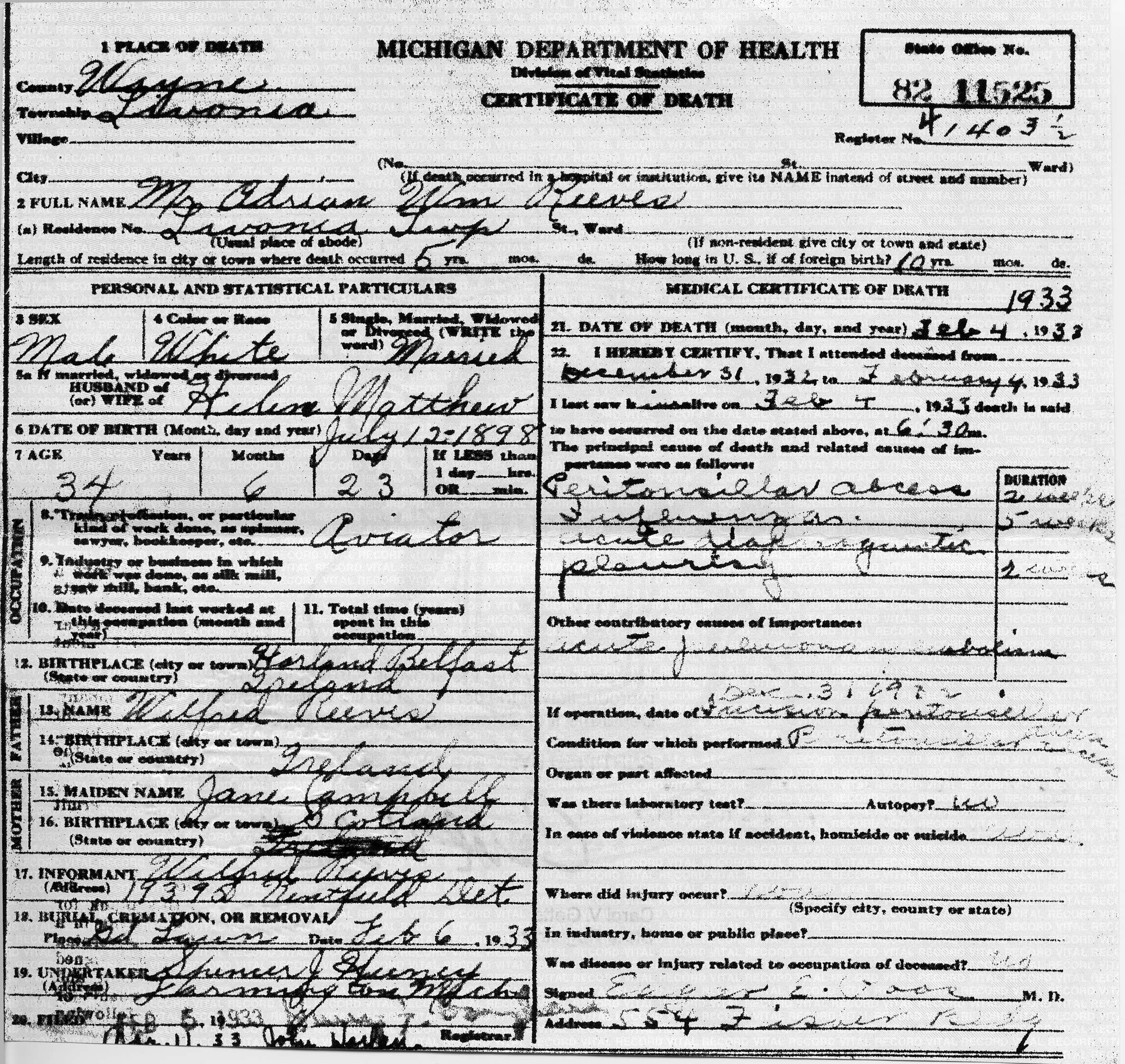
AWE Death Certificate

/Genealogy/BMD Certificates-Graves/Death/AWEReevesDeathCert1933.jpg

Using the death certificate and the 1930 census I compiled the following information:

According to his death certificate, AWE Reeves, of Livonia in Wayne County Michigan, developed a peritonsillar abscess (also called quinsy) and was being treated by an Eye and Ear Doctor named Edgar E. Poos.  On New Years Eve, 1932 he had an operation, called an incision peritonsillar, to drain the abscess. Two weeeks later he developed influenza which lasted five weeks. The last two weeks he had pleurisy (sharp pain in the chest area with each breath). He was pronounced dead at 6:30 AM on  Feb 4, 1933 by Dr. Poos. The death certificate was filed by his brother, Wilfred Reeves, who indicated his address as 19395 Kentfield in Detroit. He was buried at the Grand Lawn Cemetery on Feb 6, 1933 by the undertaker Spencer J. Heeney of Farmington. His death certificate incorrectly states his birthday as July 12, 1898; according to his birth certificate it should be 1899. Also worth noting is his place of birth which again incorrectly shows Belfast, Ireland.

A Tribute to Capt. A. W. E. Reeves

After my father’s death, an old friend, Ken Rogers, who had worked with Daddy when he was doing mechanical engineering/draughting before getting back into aviation wrote the following tribute:

A Tribute to Capt. A. W. E. Reeves

To those who didn’t know him, just a column in the press, To tell of things accomplished – surmounting war’s distress.

It told of deeds of valour, for which he got a cross, But couldn’t tell a thing about the dear one’s awful loss.

He was the perfect Father, – a husband rare indeed, A friend sincere who proved his worth were friend of his in need.

We loved him all who knew him, and knowing gained so much, A laugh, a handshake so sincere, a kindly deed or such.

He’s gone to join his wartime pals awaiting in the sky, We know he’ll lead them once again, that squadron up on high.

He’ll fly with streamers waving up in God’s Heaven above, Until he finds a landing place, a field of peace and love.

He’ll look down and see us so let’s work and try to be, Just half the man that he was, and is, – eternally.

A column in the press can’t tell, nor anything on earth, Just what this prince of fellows was, or what his sterling worth.                                              

— Ken J. R

n.b. (Kenneth J Rodgers (b.1896) is in 1930census in Wayne County District 1091, Draftsman – He had a son Robert, 5, Wife Emma – living at 11715 Otsego?? Avenue)

n.b. Border crossing shows Kenneth Harold John Rogers, wife Emma, father George

Capt. Adrian William Edmund Reeves

Capt. Adrian William Edmund Reeves,  July 12, 1899 – Feb. 4, 1933 Notes by his son, Desmond Reeves (ADR):

My father was born at “Willowdene”, 13, Marlborough Crescent, Bedford Park, Acton, England.  My wife Rita and I visited this house on Saturday, November 28, 1992 while in London on holiday.  We met the current owners who were kind enough to invite us into the house and offered us a glass of wine!  They gave me a brochure on Bedford Park, which was the first garden suburb in England. I took several pictures of the outside of the house.  While Bedford Park is technically in Acton, it is physically close to Chiswick.  We walked through the business area and bought a book on the history of Bedford Park at an old book store.

During World War I, my father served in the Royal Naval Air Service (RNAS) until it merged with the Royal Flying Corps to become the Royal Air Force.  He attained the rank of Captain. He was awarded the Distinguished Flying Cross (DFC) personally, by His Majesty, King George V in a private audience.  The citation which appeared in the London Gazette of December 3, 1918 reads:

“His Majesty the King has been graciously pleased to confer the undermentioned Rewards on Officers and other ranks of the Royal Air Force in recognition of gallantry in flying operations against the enemy:

Lieut. (A/Capt.) Adrian William Edmund Reeves (Sea Patrol, FLANDERS)

This officer has done continuous good work during the past 4 1/2 months, notably in the recent advance, when, between September 28th and October 5th, he carried out thirteen raids on enemy railway junctions.  A bold and determined fighter, he has taken part in sixty-four raids, his observer and himself shooting down four enemy aeroplanes.”

Daddy died shortly before 6 am on Saturday, February 4, 1933 at his home in Farmington, a suburb of Detroit, Michigan.   News of his death were reported in the Detroit papers and the New York Times. The Times obituary read “CAPTAIN ADRIAN REEVES British World War Aviator Was Shot Down Six Times”.

DETROIT, Feb. 4 (AP)  Captain Adrian Reeves who was shot down six times as a World War aviator, suffering nothing worse than a sprained ankle, died here today of influenza at the age of 33. Captain Reeves, who was vice president of the National Air service, Inc. of Detroit, was born in Belfast, Ireland, (Note: This is incorrect My father was actually born in England but would never admit this. No official document, including his marriage license, my and my sister’s birth certificates, his pilot’s license and driver’s license shows any city other than Belfast as his birthplace.) and joined the Royal Naval Air Service in 1915, when he was 15.  He received the Distinguished Flying Cross for leading thirteen successful bombing raids over the German lines within a few days.  He was credited officially with bringing down four planes.  The Captain came to Detroit in 1926, (Note: This, also, is incorrect.  He arrived in the US in 1922 or 1923)(Note JR – Arrived May 1922) a year after leaving England.  He is survived by a widow, a son and a daughter.

Detroit papers (names unknown) carried the following accounts of Daddy’s death:

1.  (probably the Detroit News, the article also included a picture with the caption “Airman in World War; Leader in Aviation) “VETERAN FLYER IS DEAD AT 33” Decorated by British for Daring Air raids On Germans. Capt. Adrian W. Reeves, veteran of numerous World War aerial encounters in the course of which was shot down six times and escaped with nothing more serious than a sprained ankle, died shortly before 6 a.m. today of influenza and a throat infection.  He was 33 years old.

Born in Belfast, Ireland  Capt. Reeves at 15 enlisted in the Royal Naval Air Service .  That was in 1915 and in two years he was a captain, commanding a bombing group.

DECORATED BY BRITISH He received the Distinguished Flying Cross for leading 13 successful bombing raids over the German lines within a few days. In his encounters with enemy fliers, Capt. Reeves brought down and was credited officially with four planes. His ankle was sprained when a machine gun bullet struck his shoe.

AN AIR MAIL FLIER After the war, Capt. Reeves flew the air mail between London and Cologne and between London and Berlin.  He left England for Canada in 1925 (ADR Note: This is incorrect. It was 1922) and shortly thereafter came to Detroit.  He has made his home here since that time. His first work in Detroit was as a draftsman.  Later he was a co-pilot in the Stout Air lines;  served as an instructor with the Triangle Flying Service, Inc.;  served in a similar capacity with the National Airways and then, in 1931,  joined National Air Service, Inc., Plymouth and Middle Belt roads.

SERVED AS INSTRUCTOR He was vice-president of the organization and an instructor as well at the time of his death.  Friends of Capt. Reeves estimate that since coming to Detroit he has taught several hundred students to fly. Capt. Reeves, stricken with influenza shortly before Christmas, apparently had recovered and last Saturday went to the flying field. He suffered a relapse in the evening and an infection developed.  He died in his home in Coventry Gardens, near Farmington.

He leaves his wife, Mrs. Helen Reeves;  a son, Desmond,  9 years old; a daughter Joyce, 5;  his mother, who is in Belfast and a sister, a teacher in India” (ADR Note: I don’t know who this is.  Daddy had two sisters, neither of whom to my knowledge was a teacher in India! Daddy’s brother Eric, who also lived in Detroit, was not even mentioned.)

2.  “REEVES, AIR LINE OFFICIAL, IS DEAD Capt. Adrian Reeves, one of the operators of National Air Service and for years a popular figure in Detroit air circles, died Saturday at his home near Farmington. He had been ill for six weeks.  Pneumonia  set in after a heavy cold and his death was the result of a severe throat infection. Enlisting in the Royal Air Force in 1916, Reeves saw service on the Western Front and in Mesopotamia.  He was one of the original bomber pilots and s a pursuit flier shot down four German planes. He was made a Captain at the age of 19.  (ADR Note: This is a very garbled story. !!  I have no idea where they got Mesopotamia !)

After the war, Reeves flew on the first mail line between London and Cologne.  He came here in 1922 and has been prominent as an instructor and operator since that time A widow, Helen and two children, Desmond 5 and Joyce, 3. survive.” (ADR Note: These ages are, of course, incorrect.)

3. “CAPT. A. W. REEVES’ FUNERAL MONDAY Famous Flier Was Victim of Influenza. Funeral services for Capt. Adrian W. Reeves, veteran military and commercial flier, are to be held at the Heeney Chapel,  23720 Farmington Road, Monday at 2 p.m.  Capt. Reeves died Saturday of Influenza and a throat infection. Gerald Black and Harold H. Strickland, associates of Reeves in the operation of National Air Service, Inc. plan to fly two planes over the chapel in an “element” formation, leaving the position normally occupied by the third plane vacant, to signal the loss of a comrade. Pall bearers will be pilots whom Reeves taught to fly or with whom he was associated. Capt. Reeves was one of the outstanding flying instructors in the Detroit area.  He came here from England eight years ago, following distinguished service with the British Royal Flying Corps in the world war.  He led successfully 13 bombing raids over German territory, for which he was decorated.”